
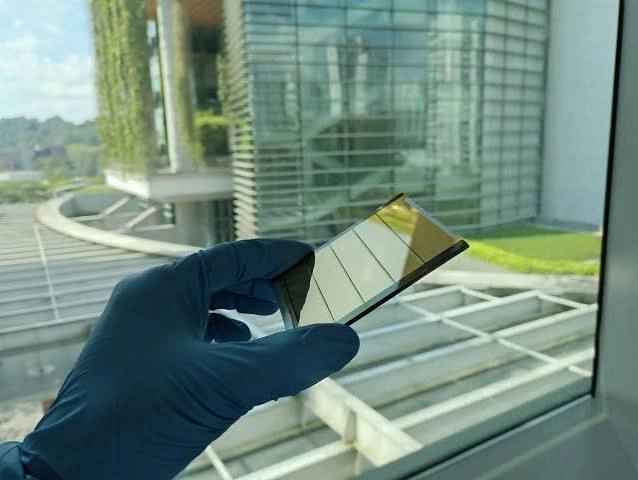
When you look at BIPV facades, the real issue is not whether glass can generate electricity. The harder question is whether it can still behave like facade glass after you add power generation into the system.
That is where GLASVUE becomes worth your time. Its Perovskite PV Glass is built for architectural use rather than rooftop add-on use, and that changes the conversation. You can also review the company’s production capabilities, read more about the manufacturer, or go straight to the contact page if you already have facade drawings in hand. In practice, that matters, because BIPV facade work usually fails or succeeds on glass logic first, then on solar logic.
Why Does It Fit BIPV Facades Better Than Traditional Solar Modules?
Transparent Energy Generation
A facade is not a roof. It has to handle daylight, outward view, facade rhythm, interior comfort, and street-level appearance all at once. Traditional solar modules can generate power, but they usually bring a heavy visual block with them. That is fine on a rooftop. It is often a problem on a curtain wall.
That is where Perovskite PV Glass stands apart. It works as a power-generating glazing material, not as a panel bolted onto the building skin. So if you are designing a tower facade, an office window wall, or a glazed atrium edge, you are not forced into that old choice between a clean facade and an active energy surface.
Building Envelope Logic
In BIPV work, the glass should not be treated as decoration with wires. It is part of the envelope. It still needs to meet facade expectations for safety, weather resistance, light admission, and compatibility with frame systems. The attachment makes this point quite clearly. In a normal window or curtain wall build, the outer lite can be replaced by laminated power-generating glass while keeping the overall system within standard architectural logic.
That sounds obvious, maybe even dull, but it is the big difference. A material that replaces part of the envelope is much easier to integrate than a separate energy device that sits on top of it.
Low-Light Urban Conditions
Facade glass rarely faces textbook sunlight all day. It deals with reflected light, cloudy mornings, partial shade from nearby buildings, and changing angles across the year. That is why low-light harvesting matters in real projects. On paper, everyone talks about peak sun. On site, you live with mixed conditions.
What Technical Traits Actually Matter in Facade Use?
Perovskite PV Glass Structure
The structure is one reason this product fits facade work better than many people expect. The published build is a laminated make-up: 6 mm float glass + 0.76 PVB + 0.57 perovskite PV film + 0.76 PVB + 6 mm float glass. That already puts it closer to architectural laminated safety glass than to a simple exposed photovoltaic sheet.
This matters because laminated construction gives you a better base for safety, acoustic value, and integration into window and curtain wall systems. For facade consultants and window manufacturers, that is a much more familiar route.
Visible Light and View Quality
Transparency is not a small detail in BIPV facades. It is one of the main reasons many facade teams hesitate before specifying solar glass. If the glass kills the view, darkens the interior too much, or breaks the facade composition, the energy gain will not save the design.
The published product data gives this material up to 85% visible light transmittance, which is why it can stay relevant for windows, curtain walls, skylights, and glazed public spaces. The uploaded facade notes also show that the edge absorption band can be controlled so the effect on visible area stays limited. In one 600 × 1200 mm sample calculation, the affected area is about 0.07 m², or 9.8%. That is not nothing, but it is also not a full visual block, and that distinction matters.
Published Product Data
Below is a compact view of the figures most useful in facade discussions.
| Item | Published Data |
| Product Structure | 6 mm float glass + 0.76 PVB + 0.57 perovskite PV film + 0.76 PVB + 6 mm float glass |
| Visible Light Transmittance | Up to 85% |
| Power Density | Up to 60 W/m² |
| Sound Transmission Class | 39 dB |
| Max Static Load | +3000 Pa |
| 6+6 Sample Rated Maximum Power | 35 W |
| 6+6 Sample Module Efficiency | 5% |
| Appearance Warranty | 15 years |
| Linear Output Warranty | 25 years |
Those numbers are useful because they show you the product is not being sold as a vague concept. It is already being framed as a buildable glass product with facade-relevant performance data.
How Does It Improve Facade Performance Beyond Power Generation?
Thermal Behavior
Perovskite PV Glass is useful only if it helps the building as glass first. The uploaded technical material gives a practical comparison here. A 5+0.76+5 laminated transparent outer build is listed at about 2.8 to 4.0 W/m²K, while ordinary 6 mm clear glass is put around 5.0 to 5.5 W/m²K. That means the laminated power-glass route can slow heat transfer more effectively than a simple single lite.
For BIPV facades, that is important because power generation alone does not solve cooling load, solar gain, or occupant comfort. If the facade can generate electricity and still improve the thermal side of the envelope, then the specification starts to make more sense financially.
Acoustic Benefit
Facade teams sometimes forget sound until late in the project. Then the site turns out to face traffic, a station, a dense commercial street, or a busy school edge. At that point, the glass build suddenly matters a lot.
The acoustic data in the uploaded sheet is useful here. Standard laminated builds are listed at 35 dB, 39 dB, 41 dB, and 42 dB depending on thickness and layering, and laminated insulated structures can also reach 42 dB. The same notes also compare 5+0.76+5 laminated transparent glass with 6 mm clear glass and show a clear gain in weighted sound reduction. If your facade sits in a noisy city zone, that extra control is not a side benefit. It is part of the reason to choose the system in the first place.
Safety and Load Capacity
Facade glass also has to deal with wind load, edge stability, and breakage behavior. The attachment notes that replacing the outer lite with laminated glass can raise strength and stiffness by not less than 10% in window or curtain wall use, while the standard product sheet lists a max static load of +3000 Pa.
Again, this is where the material feels different from a rooftop module mindset. It is not just there to collect energy. It still has to survive as facade glass.
Where Does It Create the Most Value?
Office Curtain Walls
The value of Perovskite PV Glass shows up clearly in office towers and commercial curtain walls. These projects usually care about facade image, daylight, ESG targets, and operating cost at the same time. A glass product that can produce power, keep a transparent appearance, and still sit inside curtain wall logic is easier to justify than a visible external solar layer.
Residential Windows and Balustrades
In residential work, the logic shifts slightly. Homeowners and developers tend to care more about visual comfort, daylight, and daily electricity support for lighting or smart systems. Balcony balustrades, larger windows, and glazed sun-facing edges are usually the first places where this kind of glass makes sense. It stays closer to normal residential glazing language, which helps acceptance.
Public Buildings and Institutional Projects
Stations, airports, schools, and civic buildings are another good fit. These projects often need visible sustainability, strong safety logic, and a facade story the public can read at a glance. A transparent generating surface does that more gracefully than a dark add-on panel system. That is especially useful in projects where the facade is part of the public image, not just a wall.
What Should You Check Before You Specify It?
Transparency and Output Balance
Do not judge the product by one power figure alone. In facade work, transparency, daylight quality, visual comfort, and output have to be balanced. A higher output number is not automatically better if it pushes the facade too far away from the architectural brief.
Frame and Cavity Coordination
The uploaded notes point out that when laminated power glass replaces a conventional outer lite, the glass pocket and frame groove may need to widen because the overall build becomes thicker. That is a detail people sometimes leave too late. It should be checked early, before the facade package gets locked.
Processing and Technical Support
This is one reason advanced architectural glass processing still matters. Large-format tempering, lamination quality, glass flatness, and coordination with IGU structures are all part of the final result. If the supplier only has solar language and not facade language, you may end up with a product that sounds innovative but becomes awkward in actual detailing.
Why Choose This Supplier for Your Next BIPV Facade?
Custom Glazing Combinations
One clear strength here is the ability to turn the power-generating glass into more than one facade configuration. The official product information already points to acoustic laminated IGU for noise reduction and Low-E combinations for stronger thermal insulation. That matters because real projects rarely want one single glass build everywhere.
Architectural Glass Manufacturing Depth
The manufacturing side also fits facade work well. The published capability pages point to 85% automation, large-format handling up to 3300 × 6000 mm, and experience with tempered, laminated, and insulated glass systems. For BIPV facade applications, that kind of architectural glass background is not extra. It is the base requirement.
Drawings, Samples, and Project Review
If you are working on a tower facade, a glazed podium, a public building, or a residential package, the next practical step is not guessing from a rendering. It is sending drawings, target performance, and facade locations for review. In short, Perovskite PV Glass works best when it is treated as part of the building envelope from day one, not as a late sustainability add-on.
FAQ
Q: Can Perovskite PV Glass really be used in curtain wall and facade systems?
A: Yes. That is one of its main differences from conventional module thinking. It is built as laminated architectural glass, so it fits facade use much more naturally than an external opaque panel.
Q: Does Perovskite PV Glass reduce daylight too much for offices or public buildings?
A: Not necessarily. The published data gives it up to 85% visible light transmittance, so it can keep a much more transparent facade expression than many older solar-glass solutions.
Q: Is it only about generating electricity?
A: No. In facade use, it also matters that the glass contributes to safety, sound control, and thermal performance. That is why the laminated structure and the option to combine it with acoustic or Low-E systems are important.