
Tempered and toughened glass is now known for its excellent strength and clarity, but the actual thermoresistance of this glass, despite being termed “heat-resistant,” actually only proves to be fire-resistant but not fireproof. Still, this paper aims to explore how the actual serviceability of tempered glass, with a maximum temperature of 250°C for constant exposure and 300°C for short-term maximum exposure, exceeds, and the underlying reasons for tempering which exceeds the actual limit. Moreover, another important factor, which is less considered but equally significant, pertains to the spontaneous breakage of tempered glass attributable to the presence of Nickel Sulfide, and how the proper Heat Soak Testing, as a tempering measure, becomes a significant fire safeguard.
Part 1: Breaking the Myth – What is the True “Temperature Limit” of Tempered Glass?
In the world of modern architecture, tempered glass is often hailed as the “steel” of transparency—strong, durable, and seemingly invincible. However, when it comes to thermal endurance, there is a widespread misconception about its limits. Does “heat-resistant” mean “fire-proof”? Not exactly. To design safe and lasting structures, we must distinguish between marketing shorthand and scientific reality.
The Science Behind 250-300°C
When we talk about the temperature limits of tempered glass, we are generally referring to two distinct concepts: Maximum Continuous Service Temperature and Instantaneous Heat Tolerance.
- Maximum Continuous Service Temperature: This is the temperature range (typically around 250°C to 250°C) that tempered glass can withstand over a prolonged period without degrading its structural integrity. Exceeding this limit for extended durations can lead to “detempering,” where the glass gradually loses its pre-stress and reverts to a weaker, annealed state.
- Instantaneous Heat Tolerance: This refers to the glass’s ability to survive a sudden spike in temperature. Tempered glass can often endure short bursts of heat up to 300°C, but this is operating on the edge of safety margins.
Thermal Shock: Float Glass vs. Tempered Glass
The true superpower of tempered glass lies in its resistance to thermal shock. Standard annealed (float) glass is notoriously fragile when it comes to temperature fluctuations. A temperature differential (ΔT) of just 40-50°C across a single pane is often enough to cause catastrophic failure. This is why a standard window might crack on a freezing day if a heater is placed right next to it.
In stark contrast, tempered glass boasts a ΔT tolerance of 200-300°C. This capability makes it the material of choice for facade spandrels, industrial observation windows, and environments subject to rapid thermal cycling.
Visualizing Thermal Stress
Why does glass break under heat? The culprit is low thermal conductivity. Glass does not distribute heat efficiently. When a glass pane is exposed to sunlight or a heat source, the center heats up and expands, while the edges (often shaded by the frame) remain cool and rigid. This creates tensile stress at the edges.
- Float Glass: Has no internal mechanism to resist this tension. Once the tensile stress exceeds the inherent strength of the glass edge, a crack initiates and runs.
- Tempered Glass: During the tempering process, the glass is heated to ~620°C and rapidly cooled (quenched). This locks the surface in a state of high compression (the “pre-stress layer”) while the core remains in tension. This internal compressive shield effectively “cancels out” the external tensile stress caused by heat, allowing the glass to endure extreme temperature variances that would shatter ordinary glass instantly.
Part 2: The Industry’s Hidden Reef – Spontaneous Breakage and the “Time Bomb” of NiS

Even with superior thermal resistance, the glass industry faces a silent, unpredictable adversary: Spontaneous Breakage. This phenomenon keeps facility managers and architects up at night—a pane of tempered glass, installed for years without incident, suddenly shattering with no external impact, load, or warning.
What is Spontaneous Breakage?
Spontaneous breakage is the sudden failure of tempered glass caused by internal inclusions rather than external force. While rare, it is a significant safety hazard, particularly in high-rise curtain walls where falling glass poses a risk to pedestrians, or in critical industrial barriers.
The Microscopic Killer: Nickel Sulfide (NiS)
The primary culprit is a microscopic impurity known as Nickel Sulfide (NiS). These tiny stones (often smaller than 0.1mm) are formed during the float glass manufacturing process if nickel contaminants (from raw materials or fuel) react with sulfur.
The danger of NiS lies in its phase transformation:
- The α-Phase (High Temperature): During the glass manufacturing and tempering process (at temperatures >380°C), NiS inclusions exist in a stable, compact state called the “alpha phase.”
- The Trap: Because tempering involves rapid cooling, the NiS stones are “frozen” in this alpha phase, unable to naturally revert to their low-temperature state.
- The β-Phase (The Explosion): Over time—months or even years after installation—these trapped alpha-phase inclusions slowly transform into their stable “beta phase.” This transformation is accompanied by a 2-4% volume expansion.
This microscopic expansion exerts immense internal pressure. If the NiS stone is located in the tensile core of the glass, this pressure acts like a wedge, disrupting the equilibrium of the pre-stress layer and triggering the immediate release of the glass’s stored energy. The result? The glass explodes.
Why Heat Accelerates the Bomb
Environmental heat acts as a catalyst. Direct sunlight on a facade or high ambient temperatures in industrial settings provide the energy needed to speed up the α→β transformation. What might take years in a cool environment could happen in months under high thermal stress, turning your glass facade into a ticking clock.
Part 3: The Safety Solution – Heat Soak Testing (HST) as “Hardcore” Quality Control
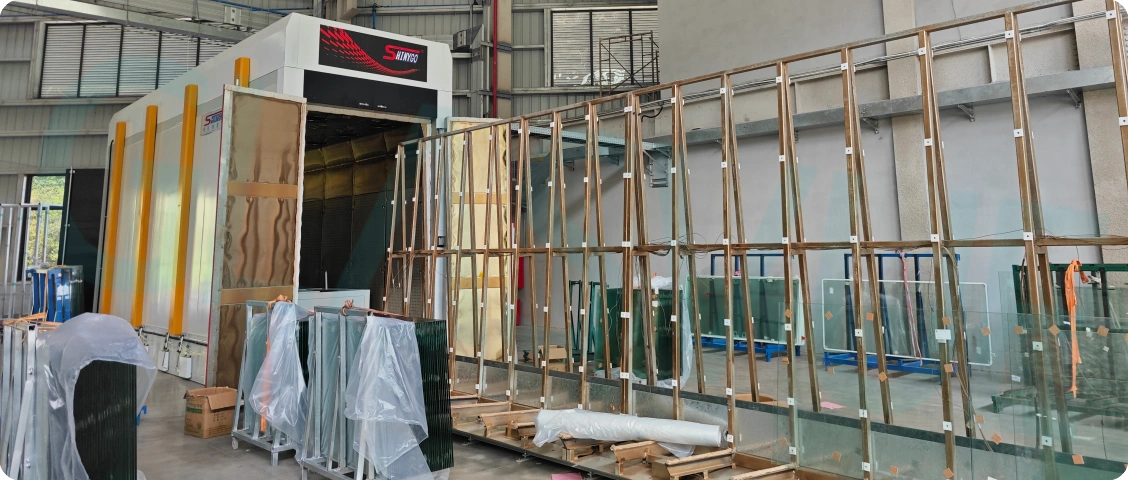
If NiS is the hidden enemy, Heat Soak Testing (HST) is the rigorous boot camp designed to flush it out. HST is not just a test; it is a destructive screening process that forces potential failures to happen in the factory, not on your building.
HST: The “Live Fire Exercise” for Glass
The principle of Heat Soak Testing is simple but brutal: we intentionally recreate the conditions that cause NiS inclusions to expand, but we accelerate the process dramatically. By subjecting the glass to specific heat profiles, we force any pane containing critical NiS inclusions to break inside the test oven.
Standards and Process
At Glasvue, our HST protocols are strictly aligned with global standards such as AS/NZS 2208:1996 (Safety Glazing Materials in Buildings) and ANSI Z97.1-2015. While regional standards vary, the core physics remain the same.
A typical Heat Soak cycle involves three key phases:
- Heating Phase: The glass is gradually heated to a temperature of approximately 290°C (±10°C).
- Holding Phase: The glass is held at this peak temperature for a specified duration (typically 2 to 4 hours, depending on the standard, e.g., EN 14179 requires a minimum of 2 hours at 290°C). This specific temperature range is crucial—it maximizes the speed of the α→β conversion without detempering the glass.
- Cooling Phase: The glass is slowly cooled back to ambient temperature.
Why HST is Irreplaceable
Currently, there is no technology capable of scanning for NiS inclusions on a production line—they are simply too small. HST remains the only effective, mature physical method worldwide for screening out NiS-contaminated glass.
The Data Speaks:
- Without HST: The industry average risk of spontaneous breakage due to NiS is roughly 1 in 400 to 1 in 500 panes (depending on batch quality).
- With HST: The risk drops significantly. A properly executed Heat Soak Test eliminates over 95-98% of NiS-infected panes. While no process can claim 100% elimination (due to “sub-critical” inclusions), HST transforms a probabilistic gamble into a statistically manageable safety margin.
Part 4: Glasvue’s “Superior” Gene – Defining True High-Performance Tempered Glass
At Glasvue, we believe that meeting the standard is just the starting line. With nearly three decades of industry expertise and a mission to be “Beyond a vendor, your ally in architectural excellence,” we define high-performance glass not just by how it looks, but by how it behaves under the most extreme conditions.
Beyond Standards: Preempting Risk
We understand the anxiety architects and engineers feel regarding the 250-300°C thermal limits. It’s not just about whether the glass can survive the heat; it’s about whether it can survive it safely.
Glasvue’s “Superior” gene is built on a foundation of precision and redundancy:
- Precision Manufacturing: Our two state-of-the-art production sites (spanning 10,000 sqm) are equipped with $7 million in imported machinery from Italy and Germany. With an automation level of over 80%, we ensure that the tempering stress layers are perfectly uniform. Uniform stress means consistent thermal performance and fewer weak points where thermal shock could initiate failure.
- Rigorous HST Protocols: We don’t view Heat Soak Testing as an optional extra; for critical applications, it is a mandate. Our HST ovens are calibrated to ensure every inch of the glass reaches the target temperature, leaving no “cold spots” for NiS to hide. This is how we confidently supply glass that reduces spontaneous breakage risks to near-zero.
Application Cases: Where Performance Matters
Our safety-first approach has made Glasvue the preferred choice for projects where failure is not an option:
- High-Rise Curtain Walls: Where replacing a shattered pane at 50 stories high is a logistical nightmare and a safety hazard.
- Industrial Observation Windows: In factories where glass faces constant high heat (up to 250°C) from machinery. Our HST-treated glass ensures that thermal stress doesn’t trigger a spontaneous NiS break in these high-risk zones.
- Fire-Rated Partitions & Exit Corridors: Where structural integrity under thermal load is a matter of life and safety.
By combining premium float glass selection, precise tempering control, and uncompromising Heat Soak Testing, Glasvue delivers a product that alleviates the “thermal anxiety” of modern design.
Conclusion: Choosing Glass is Choosing Safety Redundancy
In the complex equation of architectural specification, temperature ratings are only one variable. The true value of a glass product lies in its safety redundancy.
A sheet of tempered glass that can withstand 300°C is impressive. But a sheet of tempered glass that can withstand 300°C and has been rigorously Heat Soak Tested to eliminate internal threats is complete.
In environments defined by high thermal stress, skipping HST is akin to driving a car without an airbag. You might never need it, but the cost of not having it is too high. At Glasvue, we provide more than just glass; we provide the peace of mind that comes from knowing your vision is built on the safest, most reliable foundation possible.
FAQ
Q: Can Glasvue’s tempered glass resist temperatures above 300°C?
A: While our standard tempered glass has an average working temperature of about 250°C and tolerates instantaneous maxima of up to 300°C, for use in applications where the temperature exceeds 300°C, we actually suggest looking into our specialty fire resistant glass offering or borosilicates for much superior heat resistance.
Q: Can Heat Soak Testing (HST) assure that the glass will never break on its own?
A: While no process can mathematically ensure a failure rate of 0%, HST is presently the most reliable process, providing over 95% protection against spontaneous breakage, and removes the vast majority of critical NiS inclusions. In environments with no tolerance for breakage, we would recommend installing Heat Soak Tested Laminated Glass, providing the customer with the reassurance that, even in the case of a break, the glass would, in fact, remain bonded to the interlayer.
Q: Is Heat Soak Testing necessary for all tempered glass projects?
A: Not necessarily. HST is strongly recommended for “critical” applications—such as high-rise exterior facades, overhead glazing (skylights), balustrades, and areas with high thermal stress or difficult access for replacement. For standard low-level interior applications (like shower screens or partitions) where breakage poses minimal safety risk and replacement is easy, standard tempered glass is often sufficient. However, Glasvue advises consulting with our technical team to determine the best safety redundancy for your specific project.
Meta Description: Discover the science behind tempered glass thermal limits (250-300°C), the hidden risks of Nickel Sulfide (NiS) spontaneous breakage, and how Glasvue’s Heat Soak Testing (HST) ensures superior safety for high-performance projects.