
Introduction: The Justification for Why New Structural Design Techniques No Longer Use Traditional Laminated Glass
In the modern architectural environment, the need for transparency, minimalism, and safety has enabled glass to evolve from a merely ornamental infill material to a prominent structural element. PVB or Polyvinyl Butyral reigned supreme as a safety material in the industry for several decades and brought a paradigm shift through its material properties, as it ensured that the glass stuck to each other even after being broken.
However, as architects began to design glass fins, overhead canopies, glass floors, and frameless balustrades, the inherent limitations of PVB became apparent. PVB is essentially a “soft” polymer. While excellent for energy absorption and impact safety (such as in automotive windshields), it lacks the mechanical stiffness required to carry significant structural loads or maintain integrity after breakage in demanding environments.
Enter SGP (SentryGlas® Plus), an Ionoplast interlayer. The leap from PVB to SGP represents a fundamental shift in material science: moving from a safety film to a structural engineering material. At GlasVue, we have witnessed this evolution firsthand. Our commitment to pushing the boundaries of architectural glazing requires us to utilize materials that don’t just meet the building code—they redefine what is possible in glass engineering.
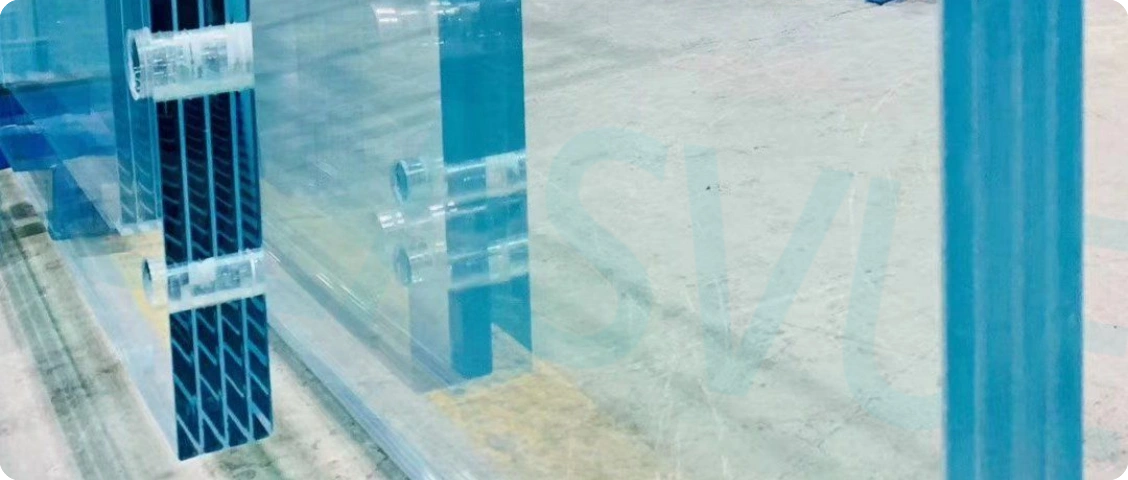
Chapter 1: The Core Technical Duel—Shear Modulus and Tear Strength
To understand why SGP is superior for structural applications, we must look at the physics of how the interlayer interacts with the glass plys.
1.1 The Magic of Shear Modulus
The most critical differentiator between SGP and PVB is the Shear Modulus. In laminated glass, the interlayer’s job is to transfer shear forces between the two layers of glass.
- The PVB Reality:PVB is a viscoelastic material. Under load, especially in warmer temperatures, it behaves almost like a thick liquid. This results in “slippage” between the glass panes. When the panes slip, the laminate loses its composite action, and the two pieces of glass act independently. This significantly reduces the overall strength and increases deflection.
- The SGP Advantage:SGP is up to 100 times stiffer than standard PVB. It creates a powerful mechanical bond that allows the laminated unit to act as a “monolithic” piece of glass. Because the SGP prevents the panes from sliding past each other, an SGP laminate can carry the same load as a PVB laminate but with significantly less thickness, or conversely, carry much higher loads at the same thickness.
For engineers, this means SGP provides predictable, high-performance structural stability even under long-term loading and high temperatures, where PVB would typically soften and fail.
1.2 Tear Strength: A 5-Fold Increase
Beyond stiffness, Tear Strength defines how a material resists the propagation of a crack or the penetration of an object.
SGP has a tear resistance approximately 5 times stronger than PVB. This technological advance is a key requirement in a high-security and extreme weather environment. In a situation like a high-velocity impact (like wind-borne debris in the event of a hurricane), the presence of the SGP interlayer will result in the glass being much less likely to be breached. Even if the glass is damaged, the presence of the SGP layer acts as a very effective barrier.
Chapter 2: The Lifeline—Post-Breakage Strength and Structural Integrity
The true test of a structural material isn’t how it performs when it’s intact, but how it behaves when it fails. In the world of glazing, “safety” is defined by the post-breakage behavior.
2.1 Simulating Breakage Behavior: “Soft” vs. “Hard” Failure
When tempered glass breaks, it shatters into thousands of small fragments.
- PVB: The “Falling Blanket.”If both layers of a PVB-laminated glass unit break, the interlayer lacks the inherent stiffness to hold itself up. The glass typically collapses out of the frame like a wet blanket. For overhead glazing or glass railings, this “soft failure” can be catastrophic, leading to immediate danger for those below or a complete loss of a fall-protection barrier.
- SGP: The “Rigid Shield.”SGP behaves fundamentally differently. Even if both panes of glass are shattered, the SGP interlayer remains rigid. It possesses enough residual stiffness to keep the glass fragments locked in place and, more importantly, to keep the panel upright and in the frame. This creates a “hard” structural support that provides a critical “buffer time” for evacuation or replacement before the system eventually loses integrity.
2.2 Extreme Conditions: Hurricanes, Blasts, and Security
GlasVue’s high-performance SGP solutions are frequently deployed in regions prone to extreme weather. In hurricane-impact testing, SGP is often the only material capable of passing the most stringent “Large Missile Impact” tests while maintaining the seal of the building.
Furthermore, in blast-resistant glazing, SGP’s ability to absorb massive amounts of energy without tearing makes it the preferred choice for government buildings, embassies, and high-risk commercial infrastructure. It doesn’t just stop shards; it absorbs the shockwave while remaining a physical barrier.
Chapter 3: Application Scenarios—When SGP is Non-Negotiable
While PVB is suitable for many standard applications, there are specific architectural scenarios where SGP is the only viable engineering choice.
3.1 Frameless Glass Balustrades
The “all-glass” look is a hallmark of modern luxury design. However, using PVB in frameless balustrades often leads to two major issues:
- Edge Delamination:PVB is sensitive to moisture. When the edges of the glass are exposed (common in frameless designs), PVB tends to absorb moisture, leading to “clouding” or delamination—the unsightly white bubbles seen on the edges of cheap glass railings. SGP is chemically different and far more resistant to moisture, ensuring the edges stay crystal clear for decades.
- The “No-Handrail” Design:In many jurisdictions, building codes allow for the removal of a supportive metal handrail only if the glass can remain upright after breakage. Because SGP provides this post-breakage residual strength, it enables the truly minimalist “floating” glass look that GlasVue clients desire.
3.2 Glass Fins and Full-Glass Facades
In total-vision systems, glass fins serve as the structural “mullions” that resist wind loads. These fins are under constant stress. Using PVB for a glass fin is risky because of its tendency to creep under load. SGP provides the necessary rigidity to act as a structural beam, allowing for taller, thinner, and more transparent facades.
3.3 Glass Floors and Stair Treads
Walking on glass requires both actual safety and psychological security. Glass floors must be able to withstand heavy live loads. If a glass floor made with PVB were to crack, it might sag or fall through. An SGP-laminated floor ensures that even in a worst-case breakage scenario, the floor remains a stable platform, preventing a fall from height and giving occupants the confidence to move safely.
Chapter 4: Costs, Myths, and Strategic Selection

A common misconception is that SGP is simply “too expensive” compared to PVB. While the raw material cost of Ionoplast is higher, a holistic Total Cost of Ownership (TCO) analysis often proves otherwise.
4.1 The Selection Matrix: PVB vs. EVA vs. SGP
At GlasVue, we guide our clients through a strategic selection process:
- Standard PVB:Ideal for residential windows, interior partitions, and acoustic insulation. It is cost-effective and provides excellent sound dampening.
- EVA (Ethylene Vinyl Acetate):Best for decorative glass (encapsulating fabrics or metals) and for use in highly humid environments like bathrooms or outdoor areas where liquid moisture is constant but structural requirements are low.
- SGP (Ionoplast):The “Must-Have” for exterior curtain walls, glass fins, railings, overhead canopies, and any application requiring high security or structural load-bearing.
4.2 Engineering Value: Thinner and Lighter
Because SGP is so much stronger than PVB, engineers can often specify thinner glass plys to achieve the same structural performance. Thinner glass means:
Lower overall weight of the glazing units.
Reduced load on the building’s primary structure and hardware.
Easier and cheaper installation.
Higher light transmission (thinner glass is clearer).
When you factor in the reduced maintenance (no delamination) and the ability to use thinner glass, SGP often becomes the more economical choice for high-end projects over the building’s lifespan.
Conclusion: Choosing SGP, Choosing the Future of Architecture
The evolution of architecture is moving toward a future where the boundaries between the interior and exterior are blurred. This “limitless” transparency can only be achieved safely through the use of advanced materials like SGP Ionoplast.
SGP is more than just a layer of plastic; it is an enabling technology. It allows architects to dream bigger, engineers to design thinner, and owners to rest easier knowing their buildings are protected by the highest standard of structural glazing.
At GlasVue, we specialize in the custom fabrication of SGP-laminated glass tailored to the most demanding specifications. Whether you are designing a coastal villa that must withstand hurricane forces or a sleek commercial atrium that demands total transparency, we have the expertise to bring your vision to life.
Ready to elevate your next project? Contact the GlasVue team today for a professional consultation and custom SGP structural glass solutions.
Frequently Asked Questions (FAQ)
Q: Can SGP be applied to any type of glass, even colored glass or Low E glass?
A: Yes, SGP is compatible with a variety of glass types such as clear glass, tinted glass, low iron glass, and even the high-performance coatings of Low-E glass. And indeed, the use of SGP in low iron glass is actually the best choice of architects for new structures.
Q: Does SGP provide better UV protection compared to PVB?
A: SGP is known to offer top-class protection against UV rays, blocking more than 99% of UV rays. PVB is also known to provide strong protection against UV rays, but SGP is more stable compared to PVB and does not yellow easily even if it is exposed to direct sunlight.
Q: Is SGP a legal requirement in every case involving railings made from glass?
A: It depends on the local building codes. But in “top-cap-free” or frameless glass railings, where there’s a risk of falling from a height, modern building codes, such as the IBC in the US, in effect require the use of an ionoplastion-interlayer like SGP because it is among the only materials with the ability to achieve the requirements for stability after breakage. It is important to check this with a structural engineer for your design.