
Current designs for business building exteriors are shifting from just chasing high strength to finding a good mix of safety, flatness, and visual uniformity. Fully tempered glass, known as FT, offers great toughness, but it comes with built-in risks like nickel sulfide explosions and roller wave distortions that pose problems in top-end skyscrapers and luxury hotel builds. Heat-strengthened glass, with its special stress setup, fixes these issues well.
This report draws on heat science basics and building structure studies to explain why heat-strengthened glass stands out as essential.
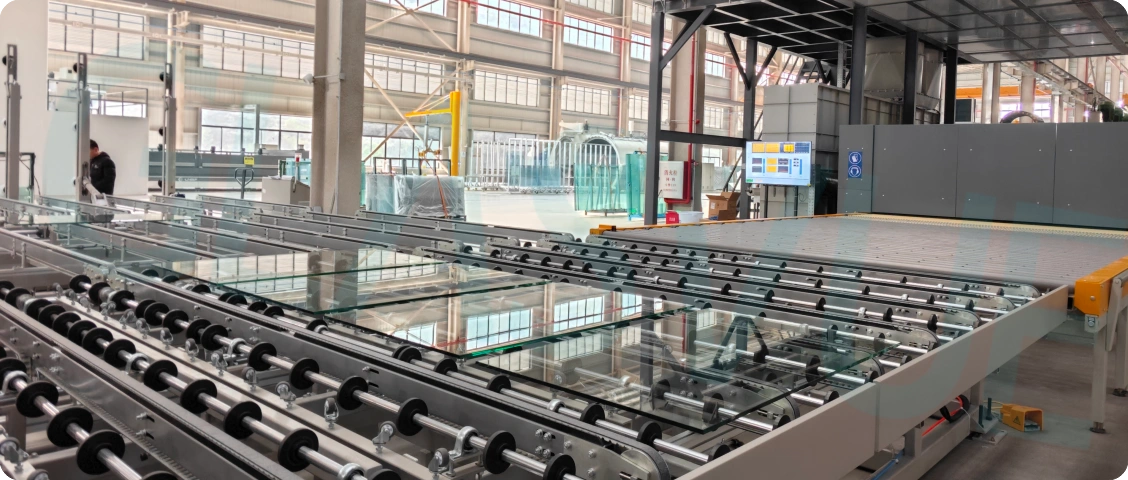
Technical Dive: Heat-Strengthened Glass Thermodynamics and Tiny Structure
Physical Core of Heat Treatment Process
To grasp the benefits of heat-strengthened glass, one must look closely at the core physics of how it gets made. Both heat-strengthened and fully tempered start by warming float glass to near its softening spot, around 600°C to 650°C, which lets the molecules inside relax for a bit. The big difference shows up in the quenching phase that follows, where rapid cooling happens.
Cooling Speed and Stress Field Creation
In the Glasvue setup with an Italian-imported automatic tempering furnace, glass leaves the oven and heads straight to the air grid area.
Fully Tempered: High-pressure cold air blasts both top and bottom surfaces for quick cooling. The outer layers harden right away, stopping any shrinkage, while the inner core stays hot and fluid. As that core cools and shrinks slowly, it pulls hard on the fixed surfaces, building up strong compressive stress there, often over 69 MPa or 10,000 psi.
Heat-Strengthened: Air pressure stays lower, and cooling goes at a slower pace. This keeps the temperature gap between surface and core small, shortening the time difference for hardening. The end result is milder surface compressive stress, kept between 24-52 MPa or 3,500-7,500 psi.
Such process variations are not merely a weaker form; they represent careful control of stress levels. With slower cooling, the glass faces less disturbance from air pressure while still soft, which greatly cuts down on surface flaws caused by uneven blower force or roller vibrations.
Differences at Molecular Level: Nickel Sulfide Phase Change Mechanics

This forms the main safety edge of heat-strengthened glass. Nickel sulfide bits are unavoidable impurities in glass materials.
At high temperatures above 380°C: Nickel sulfide exists in alpha phase, with a smaller size.
At room temperature: Nickel sulfide tends to shift to beta phase, expanding in volume by about 2-4%.
During the fast quench of fully tempered glass, nickel sulfide lacks time to change from alpha to beta phase, getting stuck in the unstable alpha form. Once installed and heated by sunlight, these particles gain energy to expand through phase shift. Because fully tempered glass holds huge internal tensile stress, even small expansions can upset the balance and cause sudden breakage.
Why Heat-Strengthened Glass Avoids Spontaneous Breaks:
Thanks to the slower cooling in heat-strengthened processing, most nickel sulfide particles get enough time to finish their phase change during cooldown, or if some alpha phase remains, the lower internal tensile stress in heat-strengthened glass means expansion forces fail to start crack growth. Thus, heat-strengthened glass earns recognition in the field as free from spontaneous breakage risks. For hard-to-reach high-altitude curtain walls, this brings major savings over the full life cycle.
Structural Engineering View: Laminated Glass Stiffness and Post-Break Behavior
This section grabs the attention of building facade engineers, marking where heat-strengthened glass shines in competition.
Fully Tempered Laminated Glass
When planning glass railings, canopies, or wide-span curtain walls, engineers need to think about worst-case scenarios, like what occurs if the glass shatters.
Fully tempered glass, due to its intense stress traits, breaks into countless tiny blunt pieces all at once upon failure. In laminated setups, such as two fully tempered layers bonded together, if both panes break at the same time from heavy impact, the whole unit loses its bending resistance instantly.
Results: The glass might slip out from point fittings or frames, or sag badly, losing all load-bearing ability and posing serious dangers to people below.
Heat-Strengthened Laminated Glass
By contrast, heat-strengthened glass shows low crack density when it breaks, with larger fragment sizes.
Interlocking System: These big pieces, held by PVB or SGP interlayers, can still form a locked structure through friction at crack edges.
Remaining Stiffness: Tests show that heat-strengthened laminated glass, even after both layers break, can handle some static loads like its own weight or a worker’s step, plus wind forces. It often stays upright without falling out of the frame right away.
| Performance Comparison | Fully Tempered Laminated Glass (FT+FT) | Heat-Strengthened Laminated Glass (HS+HS) |
| Breakage Pattern | Tiny particles | Large fragments, cracks in radial shapes |
| Stiffness After Break | Very low (less than 1% of original stiffness) | Moderate to high (up to 20-40% of original stiffness, depending on interlayer) |
| Risk of Falling Out | High (tends to fold and slide like a blanket) | Low (stays upright, allowing time for repairs) |
| Recommended Uses | Shower enclosures, indoor partitions | High-rise curtain walls, glass canopies, railings, floors |
Thermal Stress Handling: Hidden Protection Against Weather Shifts
Shadows and Heat Shocks
Business building exteriors grow more complex, with sunshades, columns, and nearby structures casting moving shadows on glass surfaces.
Scenario Example: In Melbourne’s hot summer, sunlit glass areas might reach 70°C, while shaded spots stay at 30°C. This 40°C difference creates large tensile stress inside the glass.
Limits of Annealed Glass: Regular annealed glass typically handles only 27°C to 50°C differences, based on edge quality. If the gap exceeds this, thermal cracking occurs, with breaks often starting from edges.
Heat-Strengthened Glass Thermal Capacity
The surface compressive stress in heat-strengthened glass allows it to withstand around 200°C temperature changes, which easily covers situations like these:
Tinted or Coated Glass: Dark gray or blue types absorb heat well, raising their own temperature quickly, so they need heat treatment.
Spandrel Glass: Used to hide floor slabs and HVAC gear, these areas have insulation behind them that traps heat, forming a heat pocket. Using plain glass here almost always leads to cracks, while fully tempered brings explosion replacement issues since spandrel zones are hard to access from outside. Therefore, heat-strengthened glass serves as the standard choice for spandrel areas.
Visual Appeal: Optical Flatness and Anisotropy Pursuit
Avoiding Funhouse Mirror Effects: Roller Wave Control
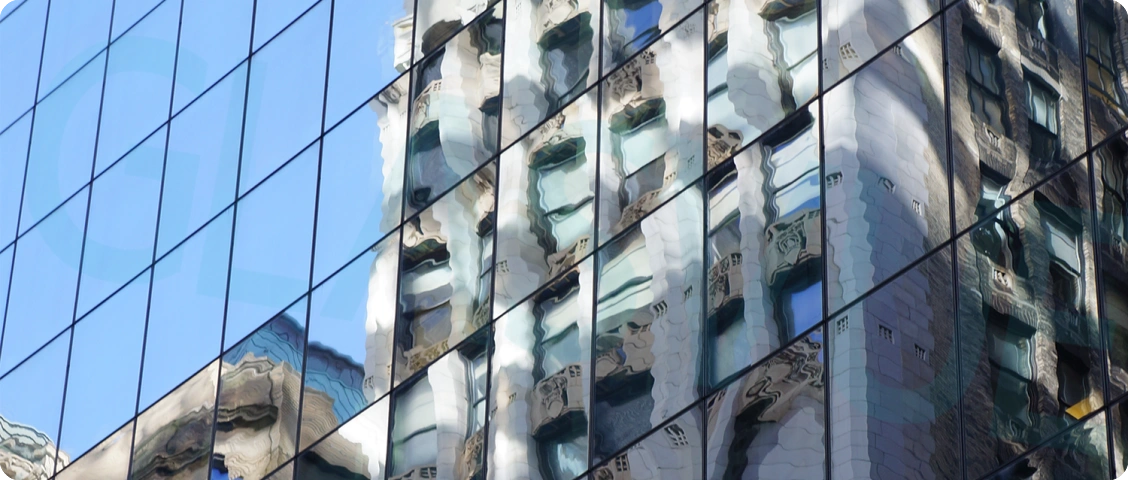
In premium commercial properties, the reflection quality of building exteriors directly affects property values. Fully tempered glass, heated to soft in the furnace and moved back and forth on rollers, suffers from quick cooling air blasts that cause slight sags between rollers, which harden into repeating waves known as roller waves.
Data Comparison: Typical fully tempered glass has wave depths of 0.15mm to 0.3mm. But Glasvue-made heat-strengthened glass, with low air pressure and gentle cooling, keeps wave depths under 0.10mm or even lower.
Visual Impact: When viewing building facades from afar, heat-strengthened glass reflects surroundings like clouds or nearby straight lines in a smooth, straight way, whereas fully tempered glass turns those lines into wavy ones.
Anisotropy: The Invisible Rainbow
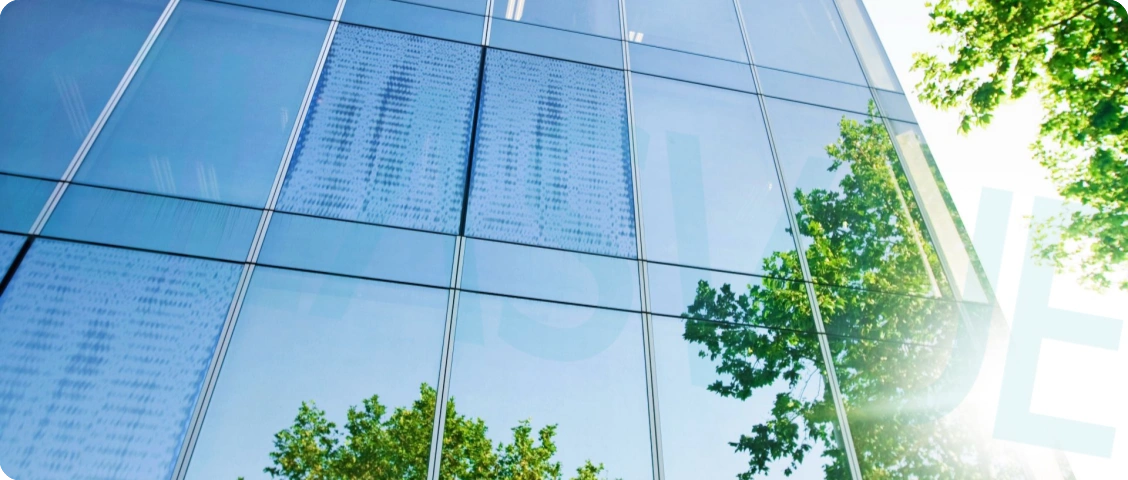
Wearing polarized sunglasses to look at some glass curtain walls reveals bothersome leopard spots or rainbow patterns, which come from anisotropy, or stress spots, due to uneven stress distribution inside the glass causing light to bend in two ways.
Heat-Strengthened Edge: Anisotropy strength links directly to stress differences in the glass. Since heat-strengthened glass has stress levels about half of fully tempered, its double refraction effect weakens noticeably. On Glasvue production lines, we use online scanners to check each piece’s retardation value in real time, fine-tuning heating zones and blower heights to drop anisotropy to levels hard for the eye to spot, ensuring clean facade visuals.
Summary
Heat-strengthened glass is not an old-fashioned tech; rather, as the building sector pays more attention to safety, visual standards, and total lifetime expenses, its key role grows stronger.
In short, fully tempered aims for safe shattering into particles, while heat-strengthened focuses on staying safe even after breaking without falling apart and avoiding self-explosions. For business buildings seeking top quality and safety, heat-strengthened glass is not a trade-off but a necessity.
For architects: It provides the only path to achieve pure, flat facade looks.
For engineers: It forms the base for high-redundancy safe laminated setups.
For owners: It removes explosion worries and cuts maintenance costs as a smart choice.
Glasvue’s Global Delivery Guarantee
For buyers overseas, product specs are just part of the picture; safe delivery matters equally. Glass, being fragile, heavy, and large, requires expert export handling. Glasvue, drawing on years of export know-how, has built a strict packaging and shipping system that tackles the common headaches of damage and moisture during transport.
Glasvue’s Manufacturing Strength
The Glasvue plant sits in Zhaoqing, Guangdong, covering over 20,000 square meters, close to major ports for easy shipping.
Key Equipment: We own Italian and German imported automatic machines worth more than 7 million USD, including precise cutters, edgers, and advanced convection tempering furnaces. This hardware ensures even stress and exact sizes in heat-strengthened glass.
Special Export Packaging Plans for Heat-Strengthened Glass
Though stronger than annealed glass, heat-strengthened glass still has delicate edges. Glasvue uses these standard packaging methods:
| Packaging Type | Suitable Scenarios | Materials and Build Details | Benefits |
| Plywood End-Caps | Standard size loose sheets, door and window glass | Covers only the ends, middle exposed. Uses fumigation-free plywood. | Low cost, quick loading and unloading, easy for customs checks, less waste disposal fees. |
| Fully Enclosed Crates | Coated glass, laminated glass, high-value shaped glass | Sealed design, lined with shock-proof foam and scratch-resistant films. | Offers top physical protection, guards against sea salt mist, ideal for long ocean trips. |
| A-Frames | Extra-large panels (Jumbo Size), full container shipments | Steel-wood mix structure, glass placed at an angle. | Very stable, prevents large panels from tipping in rough seas, easy to unload with special lifts. |
Enjoy Glasvue’s Expert Services
Glass does more than cover buildings; it acts as a filter linking indoors with the outside world. Whether you seek very low reflection for visual smoothness or aim for heat-strengthened laminated designs that stay safe even after damage, Glasvue has the tech and skills to make your ideas real.
Do not let tech details worry you. Share your project challenges with us, and we will handle the rest.
[Leave your glass needs, talk with our glass advisors]